Return To Journal
SEO Tactics for Wedding Photographers
It is not necessarily because their work is better, their business is bigger, or Google has personally decided it hates your website. They have simply given search engines stronger reasons to associate their business with that search.
That is what local SEO for wedding photographers is really about. We are building enough context around your business that Google can understand what you do, where you do it, and when your website or Google Business Profile might be relevant to someone searching for it.
Your website, Google Business Profile, location content, reviews, backlinks, and other online signals can all contribute to that understanding. The goal is to make them work together so search becomes another meaningful way couples can discover you.

Because wedding photography is inherently tied to location-specific searches.
Couples search for photographers in Charleston, Newport, San Diego, Tampa, New England, and the destinations where they are getting married. They search their venue. They search their photography style. They search combinations of all three.
And very often, they are doing that before they know your name exists.
That is what makes local SEO different from a referral. A referral begins with someone saying, “You should look at this photographer.” Search gives you an opportunity to enter the conversation before that introduction ever happens.
We want both.
We want the planner recommending you. We want your past couple sending your Instagram profile to their newly engaged friend. And we also want the person sitting on her couch at 10:30 p.m. searching “Newport wedding photographer” to have a chance of finding you too.
That is why local SEO for photographers can become such an important part of a broader marketing strategy.
Local SEO can create another source of qualified discovery, but we would never promise that ranking for one keyword automatically creates a certain number of bookings.
There are several steps between visibility and revenue.
First, someone has to find you. Then your work has to resonate. Your positioning has to make sense. Your website needs to build trust. Your experience and pricing need to align with what they are looking for. Finally, they need a clear reason to inquire.
SEO gets you into consideration. The rest of your brand still has a job to do.
That distinction is important to us because traffic for the sake of traffic is not the goal. We would rather help a photographer become more visible for searches connected to the weddings she actually wants than celebrate thousands of visits from people who were never likely to inquire.
Because your homepage is one piece of a much larger picture. If you tell Google you are a Charleston wedding photographer on your homepage, but the rest of your website provides almost no evidence that you photograph weddings in Charleston, there is not much depth behind that claim.
Now imagine the same homepage supported by Charleston weddings in the portfolio, genuinely useful venue content, locally relevant service information, internal links connecting those pages, reviews from Charleston couples, and external mentions that reinforce the same association.
That creates a much clearer picture. This is a principle we come back to constantly in modern SEO:
Not the same keyword everywhere. The same understanding everywhere.
Your Google Business Profile is one of the first places we look when working on local SEO for a photographer. And you would be surprised how often we find one that was created years ago, filled out halfway, and then essentially forgotten.
The wrong category is selected. Services are outdated. The website information has changed. Photos have not been updated in years. Reviews are coming in sporadically, if at all. Meanwhile, the photographer is publishing another blog because she thinks her website is the only place SEO happens. For local businesses, your Google Business Profile deserves attention too.
Your primary category should describe the core business as specifically and accurately as possible from the categories Google currently makes available. For a business primarily offering wedding photography, that means checking whether a wedding-specific photography category is available and appropriate rather than automatically choosing the broadest photography option.
But category selection is only one part of optimization. We also look at the business information, service areas where applicable, website connection, imagery, reviews, services, and the overall consistency between what the profile communicates and what the website communicates.
The goal is not to stuff keywords into every available field.
It is to make your business remarkably easy to understand.
And that idea extends beyond Google. Your website, directories, publications, social profiles, reviews, and other external mentions collectively create context around your business.
The clearer that context becomes, the stronger your overall local search foundation can become.
This is where SEO gets more strategic than “put your city next to wedding photographer.” Suppose you tell us you want to rank for “San Diego wedding photographer.” Great. We will research it. But then we are going to keep asking questions.
What kinds of weddings are you trying to book? Which venues matter? Are couples searching for your particular style? Are there surrounding markets worth targeting? What are your competitors already ranking for? Which searches have meaningful volume? Which opportunities are realistic based on the authority your website has today?
Keyword research gives us data. Strategy decides what to do with it.
There is no universal list we hand every photographer. A wedding photographer may target combinations of services, cities, regions, venues, styles, and questions depending on what people are actually searching and what the business wants to become known for.
A broad city search like “Charleston wedding photographer” may be incredibly valuable. A specific venue search can put your work in front of a couple much deeper into planning. A style-related search may help someone find photographers whose work aligns with what they already know they love.
But we do not automatically combine every possible modifier into something like “romantic luxury editorial documentary film wedding photographer Charleston” and call it a keyword strategy. We research how people search first. Then we build around what we find.
Absolutely, because the person looking for a wedding photographer is not searching the same way as someone hiring a brand photographer. Even within wedding photography, search behavior changes by market, price point, style, venue, and client intent.
That is why we do not build SEO strategies from generic lists of “best keywords for photographers.” The keyword needs to make sense for the business, searcher, page, and goal.
This is where photographers often discover that SEO goes much deeper than the words on the page. Your website has an architecture. Your homepage connects to services. Services connect to locations. Blogs support larger topics. Internal links show relationships between content. Navigation helps visitors and search engines understand what matters.
Or at least, that is what we want happening. In reality, photography websites tend to evolve over time. You add a page here. Publish 40 weddings there. Create a location page because someone told you to. Rename a service. Delete an old page. Redesign the website two years later.
Eventually, you can have a beautiful site with years of disconnected decisions underneath it. That is exactly the kind of thing we look for during an SEO overhaul.
It depends on the business, but your homepage, core service pages, strategically chosen location pages, portfolio or gallery content, and locally relevant blog content can all play important roles. The bigger question is not simply whether those pages exist. It is whether each one has a clear purpose.
If you have five pages unintentionally competing for the same keyword, creating a sixth is probably not the answer. If you have twenty nearly identical city pages with the location swapped out, having “more location pages” does not automatically mean you have a stronger local SEO strategy. We want each page to earn its place in the larger structure.
We look before we touch. This is non-negotiable for us. An established photographer may already have pages earning impressions, ranking for valuable searches, attracting backlinks, or contributing to the site’s authority even if she does not realize it.
We want to know that before we start changing URLs, rewriting pages, consolidating content, or rebuilding the structure. That is why competitor research, keyword research, existing performance, technical health, and site architecture all inform the strategy.
Sometimes the smartest SEO decision is changing something. Sometimes it is recognizing that something is already working and leaving it alone.
Technical SEO is the quiet powerhouse behind everything else we are doing. You can write incredible venue blogs and optimize the right pages, but if Google is struggling to crawl, index, or understand parts of the website, those efforts may have a weaker foundation than they should.
For photographers, we are particularly aware of the tension between performance and imagery. You need high-quality photographs. This is a photography website. We are never going to tell you to turn your portfolio into six tiny thumbnails because a page-speed score told us to.
But we also do not need a visitor downloading enormous image files just to see your homepage. That is where technical SEO becomes strategic rather than robotic.
We look at things like indexing, crawlability, broken links, redirects, page performance, metadata, structured data or schema, sitemap health, and other technical signals that affect how the website is accessed and understood. The goal is not a technically “perfect” website on paper. It is a technically strong website that still does its actual job beautifully.
This is one of our favorite questions because the answer should never be, “Well, I Googled myself yesterday and I think I moved up.” Search results fluctuate. They can also vary based on location, device, personalization, and the exact query. That is why we benchmark.
Before we overhaul an SEO strategy, we want to understand where the site stands today. What is already ranking? Which searches are generating impressions? Where is organic traffic coming from? Which pages are getting discovered? What technical issues exist? What opportunities can we see? Then we have something meaningful to compare against later.
We look at more than rankings. Rankings are useful because they show movement for searches we care about. Google Search Console can tell us how search visibility, clicks, impressions, queries, and pages are changing. Analytics can help us understand what organic visitors do once they reach the website.
But ultimately, we also care about what happens in the business. Are organic inquiries increasing? Are people finding you through the markets you intentionally targeted? Are the right pages starting to gain visibility? Are new search opportunities appearing as authority grows? A number moving up is nice. A strategy creating meaningful business opportunities is better.
A sitemap helps search engines discover and understand the URLs you want them to know about, particularly when pages are new or have changed. What it does not do is hand your website to Google with a note saying, “Please rank this faster.” Indexing and ranking are different things.
Submitting and maintaining a healthy sitemap is part of good technical SEO because we want search engines to efficiently discover the content we have created. Whether that content ranks depends on a much larger set of factors.
It is a small distinction, but it is exactly the kind of distinction that matters when you are building an SEO strategy instead of collecting SEO tricks.
There is no responsible universal timeline because we are not starting every photographer from the same place. A photographer with an established domain, strong backlinks, years of relevant content, and existing local authority is in a very different position from a brand-new business entering an extremely competitive market.
Competition, technical health, content, existing authority, Google Business Profile strength, and the searches you are targeting can all affect how quickly you begin seeing meaningful movement.
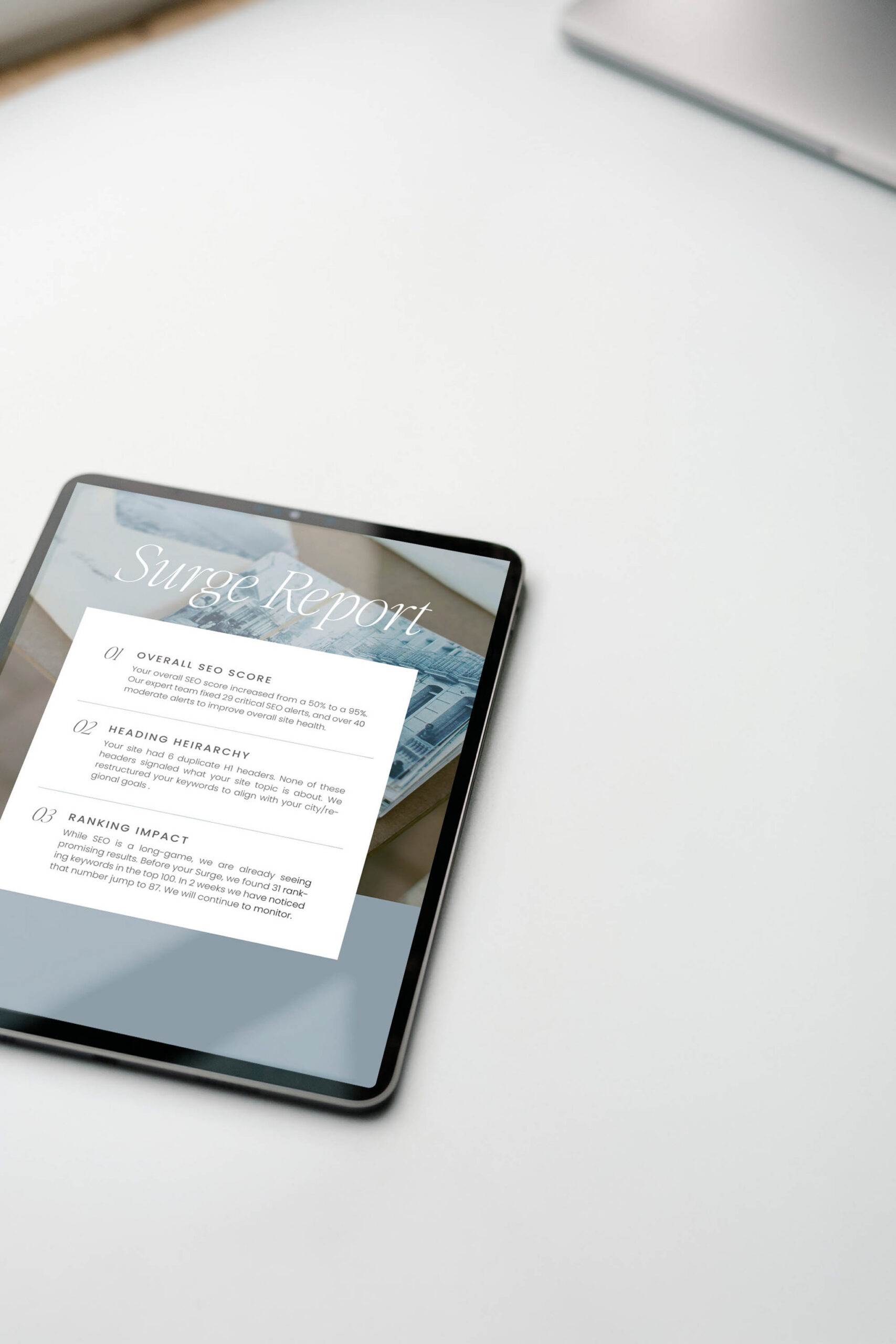
If your website has years of fragmented SEO that needs to be sorted out first, our 7-Day SEO Surge is designed to overhaul that foundation in one focused week. That does not mean rankings magically appear on Day 8. It means the work required to create a stronger foundation gets done quickly instead of sitting on your to-do list for six months.
Local SEO can help you become discoverable for searches that align more closely with the work you want. That distinction matters.
We are not interested in simply getting “more traffic.” If you are trying to photograph weddings at particular venues, establish authority in a more competitive market, or attract couples looking for a specific photography experience, your search strategy should reflect that. Then your website and positioning need to do the next job: turning that discovery into desire.
Our SEO services for photographers are built around both sides of that equation. We care about getting found, but we also care deeply about what someone finds when they get there.
No. Please do not leave this blog and create 27 identical pages with a different city name in the H1. A location page should have a strategic reason to exist and enough genuinely useful, market-specific content to warrant its own place on the website.
For one photographer, three strong market pages may make sense. Another may need a completely different structure. More pages do not automatically equal more authority. More useful depth does.
Yes. You can learn keyword research, optimize your Google Business Profile, improve on-page SEO, create location content, strengthen internal links, and understand the basics of technical SEO yourself.
If you want to be the person making those decisions, The Marketing Lab is where we teach photographers and creatives how to understand and implement modern marketing and SEO strategy.
If you would rather have us research the market, diagnose the site, build the strategy, and execute it for you, that is what our done-for-you SEO services are for.
Search your business name first. Then look beyond it. Are you being discovered by people who do not already know you exist? Are your priority services and markets earning meaningful search visibility? Are organic inquiries coming in? Do you understand what your website currently ranks for and why?
If you have been “doing SEO” for months but still feel like you are making isolated changes without knowing whether they connect, that is usually a good sign that the site needs a more strategic look.
And you do not need to diagnose the exact problem before contacting us. That is our job.
Referrals are wonderful. Instagram can be powerful. Vendor relationships matter. We want all of them. But there are also couples opening Google right now and searching for the city where they are getting married, the venue they just booked, the photography style they love, and the photographer they have not discovered yet.
That is the opportunity local SEO creates. Your website, Google Business Profile, content, technical foundation, and external signals can work together to make your business easier to understand and easier to discover. Not through one magic keyword. Not through another SEO hack.
Through a connected search strategy that gives the right people another way to find you. If you want us to build that strategy for you, explore our SEO services for photographers. If your site needs a concentrated overhaul, learn more about the 7-Day SEO Surge.
Or, if you want to learn how to make these decisions yourself, join us inside The Marketing Lab.
Your SEO strategy should match where your business is now — and where you’re trying to take it. High Tide Strategy offers SEO services for photographers, wedding professionals, and creative businesses ranging from focused optimization and ongoing expansion to complete SEO overhauls, AI visibility strategy, and education.
Not sure which level of SEO support you need? Explore our full range of SEO services, including ongoing SEO expansion, advanced search strategy, and options designed to strengthen your visibility across Google, AI search, and the platforms shaping how clients discover businesses online.
If your SEO needs more than a few adjustments, our 7-Day SEO Surge is our intensive, done-for-you SEO overhaul. We dig into the strategy, technical foundation, content, keywords, local visibility, and authority signals behind your website — then rebuild what’s holding your search performance back.
Prefer to understand and implement the strategy yourself? Inside The Marketing Lab, we break down SEO, AI search, content, website strategy, and digital marketing into practical education built specifically for creative business owners.
You don’t have to diagnose it yourself. Book a free SEO consultation and let our team get eyes on your website, where you’re currently showing up, and what may be limiting your visibility. We’ll help you determine the smartest next move based on your goals, market, and current SEO foundation.

Mandy Ford is the founder and lead strategist behind High Tide Strategy, a full-service marketing studio specializing in SEO for photographers, Showit website design, and digital marketing for creative businesses. She helps photographers, wedding professionals, and creative brands build stronger visibility across Google, AI search, and social search… then turn that visibility into qualified inquiries. Known for looking beyond surface-level SEO tactics, Mandy’s approach connects search strategy, website design, and aesthetics to build businesses that are easier to find, understand, trust, and hire online. Want to see if we’re a great fit? Reach out to schedule your free consultation.
"They made everything feel very intentional and strategic from the beginning. They took the time to understand not just my business, but the type of clients I want to attract. That gave me a lot of confidence that the investment would actually move the needle, not just improve aesthetics...."
- Catherine Cortes, RI Wedding Photographer
"I felt comfortable investing in a website design with High Tide Strategy because there is a team of people working on my website who knows their stuff when it comes to SEO, while also making my website aesthetic, and on top of that they get your website back to you within a week which is super nice!"
- Emma Rose Photography
"Mandy and her team stay on top of the latest marketing strategies and genuinely care about helping business owners succeed. I am so grateful I chose to work with them."
- Erica Ewing, Photographer & Business Coach
A full-service digital marketing agency specializing in Showit website design, Shopify website design, SEO for creatives, and paid ad strategy across Pinterest, Meta, and Google. We help photographers, small business owners, and creative entrepreneurs build intentional brands that align with their vision and drive measurable results. Our signature services include social media marketing, Pinterest management, and 7-Day SEO and Ad Strategy Surges — all designed to increase visibility, improve conversions, and simplify growth. At High Tide Strategy, we combine data-driven strategy with refined design to create marketing systems that are both beautiful and built to perform.

