Return To Journal
Keyword Mapping for Photographers (Step-by-Step SEO Guide)
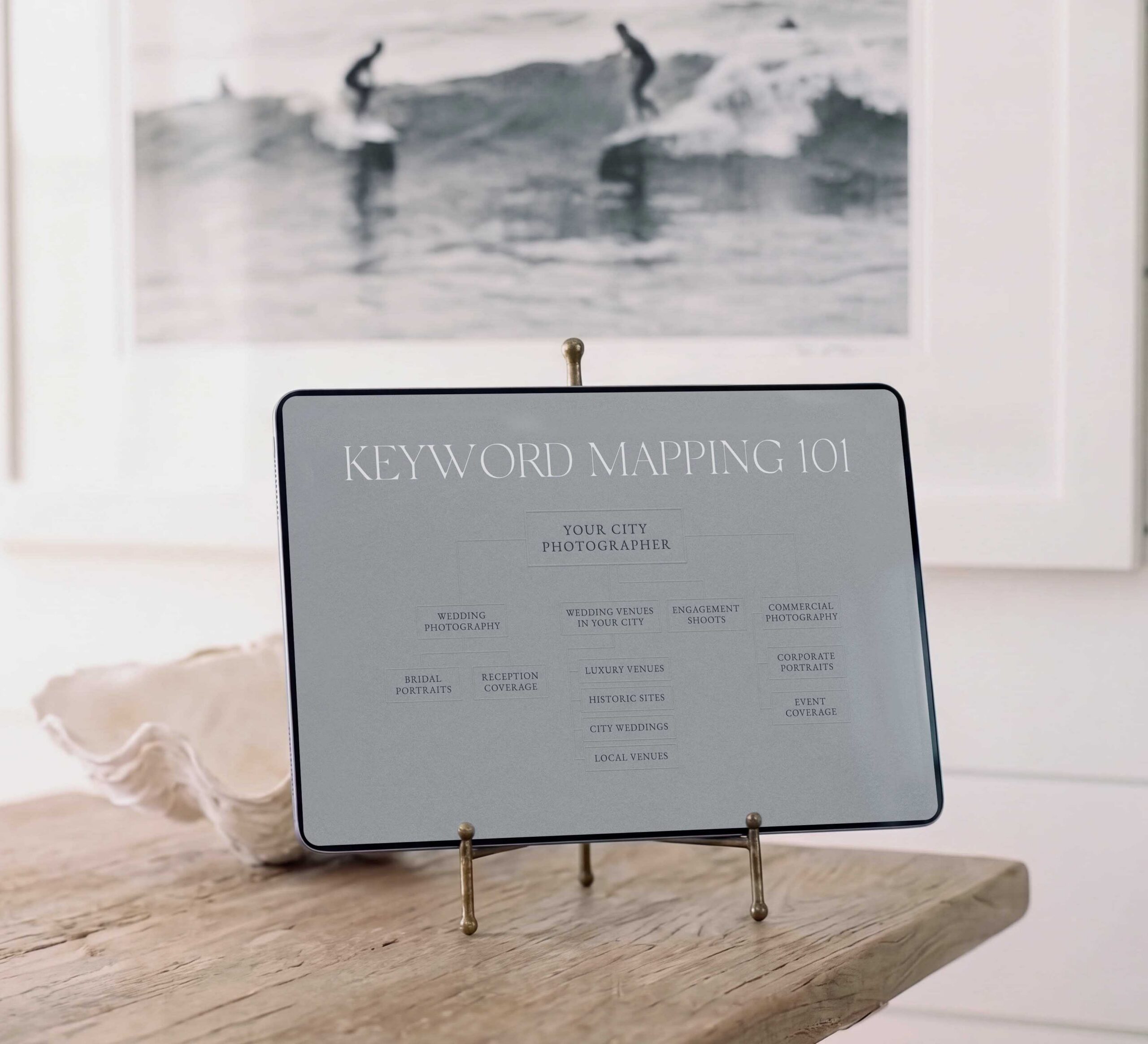
If you want to rank higher in your city, book more qualified clients, and stop guessing with SEO, keyword mapping for photographers is the foundation. Instead of publishing random blog posts or redesigning your website without direction, you start by assigning one intentional keyword to every important page.
In this guide, I walk you through how to build a keyword strategy for photographers that aligns with local SEO, city landing pages, venue SEO strategy, Google Business Profile optimization, blog structure, and long-tail keyword targeting. You will learn how to:
This is not generic SEO advice. This is a step-by-step keyword mapping strategy built specifically for wedding photographers, boudoir photographers, and creative entrepreneurs who rely on local search visibility to grow their business.
If you implement this structure correctly, your website stops feeling scattered and starts functioning like a strategic marketing system.
When I teach SEO inside Marketing Lab, I always start here because this is where most photographers go wrong. They don’t fail at SEO because they lack talent or work ethic. They fail because they build first and strategize later. They design a beautiful website, write blogs when inspiration strikes, and then hope Google figures out what they meant. I don’t hope with SEO. I decide.
Keyword mapping for photographers is the strategic process of assigning one intentional search term to every important page on your website before you touch the design, rewrite copy, or publish another blog. Instead of asking, “What should I post next?” I ask, “What do I want this page to rank for?” Every page needs a clear job. When you assign that job in advance, your website stops competing with itself and starts building authority in layers.
Most photographers think SEO means sprinkling “wedding photographer” or “boudoir session” across their site. That approach creates confusion. Google does not reward vague signals. It rewards clarity. If your homepage, blog posts, and city pages all try to rank for the same phrase, you dilute your power. Keyword mapping eliminates that overlap and replaces it with structure. Structure builds authority, and authority builds rankings.
I work primarily with wedding photographers, boudoir photographers, and creative entrepreneurs who serve specific locations. Photography is hyper-local and highly competitive. When someone searches “Austin wedding photographer” or “Kalamazoo boudoir photographer,” Google looks for precision. It evaluates whether your page clearly communicates the service, the location, and the relevance to the searcher’s intent. If your headings feel generic or your content lacks geographic clarity, Google hesitates.
When I map keywords first, I create alignment between intent and content. I decide which page targets the primary city phrase. I assign supporting regional terms to dedicated landing pages. I reserve long-tail questions for blog content. I never allow two pages to compete for the same primary keyword. That level of intention gives Google confidence about what my site represents.
Photographers often underestimate how small shifts in wording affect rankings. “Grand Rapids boudoir photographer” may carry more volume than a smaller city variation. “West Michigan wedding photographer” may outperform a hyper-specific town term. Mapping allows me to evaluate those differences before I build. Guessing after the fact wastes time and momentum.
I break keyword mapping into three layers because clarity prevents overwhelm.
First, I identify primary revenue-driving keywords. These usually belong on the homepage or dedicated service pages. For example, if I serve Charleston weddings, I assign “Charleston wedding photographer” to a specific page. That page owns the term. Nothing else competes with it.
Next, I assign supporting keywords. These reinforce authority without cannibalizing rankings. A supporting term might target engagement sessions, bridal portraits, or regional variations. These pages expand topical coverage while strengthening the primary location keyword.
Finally, I build out long-tail content. Many photographers ignore low-volume phrases because they see “0–10 searches per month” and assume it doesn’t matter. I never dismiss strong intent. A query like “what to wear to a boudoir session in Kalamazoo” may not attract thousands of visitors, but it attracts the right visitor. Long-tail content builds topical depth, internal linking opportunities, and conversion potential.
Photographers optimize after they build. They redesign their site, publish a dozen blogs, then ask why they are not ranking. That order creates frustration. I reverse the sequence. I map first. I decide which cities I want to dominate, which venues I want to target, and which services generate the highest revenue. Then I engineer my website around those goals.
When I approach SEO this way, it stops feeling chaotic. I no longer chase trends or tweak randomly. I follow a blueprint. Keyword mapping gives your website direction, and direction turns scattered effort into measurable growth.
I have never met a photographer who said, “I don’t want more qualified inquiries.” What I do hear all the time is, “I’m blogging consistently, but I’m not seeing results.” That disconnect almost always comes back to strategy. Content without keyword strategy is just noise. When I apply a clear keyword strategy, I give every piece of content a purpose that supports bookings, not just visibility.
Wedding and boudoir photography are not broad, national businesses. They are emotional, local, and highly competitive markets. If you try to rank for “wedding photographer” alone, you compete against massive directories, national brands, and decades-old domains. That battle drains energy. Instead, I narrow the focus. I combine service type, location, and intent. I target phrases like “Charleston wedding photographer,” “Austin engagement photographer,” or “Kalamazoo boudoir photographer.” That specificity increases my chances of ranking and attracts people who are ready to hire.
When I build keyword strategy intentionally, I stop chasing vanity metrics. I focus on search intent. A bride searching “best Charleston wedding venues” may not know which photographer she wants yet, but she is planning. If I publish strategic venue content tied to my city pages, I position myself early in her decision process. That visibility builds familiarity, and familiarity builds trust.
One of the biggest breakthroughs I see inside Marketing Lab happens when photographers realize that minor geographic adjustments can change everything. Many photographers lock themselves into the smallest possible city phrase because it feels accurate. Accuracy matters, but so does search volume. If “West Michigan wedding photographer” carries more demand than a small town variation, I evaluate whether that regional term aligns with my service area.
I never guess here. I compare volumes. I look at competition. I assess whether the broader regional keyword still reflects my real audience. When it does, I expand strategically. I may keep the hyper-local phrase for blog posts while positioning the regional term on a primary landing page. That layered approach allows me to capture both broader traffic and highly specific intent.
Geographic strategy also supports multi-city photographers. If I serve Columbia and Charleston, I do not overload my homepage with both cities and hope Google sorts it out. I create distinct landing pages that each target their own primary keyword. I optimize headings, imagery, and internal links for that city alone. That clarity prevents dilution and strengthens authority in each market.
Without a keyword strategy, photographers often create unintentional competition inside their own site. I see multiple blog posts targeting nearly identical phrases like “Charleston wedding venues,” “best Charleston wedding venues,” and “top Charleston wedding venues.” While slight variations can support authority, too many overlapping posts fragment ranking power.
When I map keywords first, I assign one primary term per page. I intentionally group related variations under that umbrella instead of creating separate posts for each tiny difference. That consolidation strengthens authority and reduces confusion for search engines. Google rewards depth on a topic, not scattered repetition.
The most important reason keyword strategy matters is alignment with revenue. Not all traffic converts. I prioritize keywords that reflect buyer intent. “Luxury Charleston wedding photographer” likely attracts a different client than “cheap wedding photographer Charleston.” I decide which market I want to serve before I optimize.
When I map strategically, I support my highest-value services with the strongest pages. I use blog content to nurture interest and answer objections. I optimize city pages to capture ready-to-book searches. I reinforce everything through internal linking. That structure turns SEO into a predictable growth channel instead of a random experiment.
Keyword strategy gives direction to your content, protection against internal competition, and alignment with your ideal client. Without it, you publish and hope. With it, you build authority intentionally and position yourself exactly where your future clients are searching.
If you serve a local market, local SEO is not optional. It is the foundation of your visibility. When someone searches for a wedding photographer or boudoir photographer, they almost always include a location or expect Google to understand their location automatically. If your website does not clearly communicate where you work, you limit your ranking potential before you even start.
When I approach local SEO for photographers, I begin with clarity. I choose one primary city keyword for the homepage or a dedicated landing page. I do not stack multiple cities into one headline and hope it ranks for all of them. Google prefers specificity. If I want to rank in Charleston, I build a page that confidently owns “Charleston wedding photographer.” If I want to rank in Austin, I create a separate, fully optimized page for that city.
I optimize that city page intentionally. I use the primary keyword in the H1. I reinforce it in supporting H2 headings. I mention recognizable venues, neighborhoods, and local landmarks naturally throughout the copy. I include internal links to blog posts that support that city. I treat the page like an alternate homepage that speaks directly to clients in that market.
Many photographers serve more than one city. When I see someone list three or four cities in one headline, I know rankings will struggle. Google needs clarity about which page represents which location. If you try to rank one page for “Columbia wedding photographer” and “Charleston wedding photographer” at the same time, you dilute your authority in both markets.
Instead, I build distinct city landing pages. Each page gets its own keyword target, localized imagery, and internal linking structure. I reference real sessions in that city. I mention specific venues. I answer common local questions. I create depth instead of stacking keywords.
This approach prevents internal competition and increases topical authority. It also improves conversion. When a bride lands on a page that speaks directly to her city, she feels understood. That emotional alignment supports bookings just as much as rankings do.
Sometimes a regional term carries more volume than a small-town phrase. I never ignore that data. If “West Michigan wedding photographer” outperforms a smaller city term, I evaluate whether that regional phrase reflects my real service area. If it does, I incorporate it strategically into a primary or supporting page.
I might position the regional term on a main landing page while supporting smaller cities through blog content or secondary pages. This layered strategy allows me to capture broader searches without abandoning local specificity. I always balance volume with relevance. Ranking for a broader term means nothing if it attracts clients outside your ideal market.
Local SEO does not stop at one landing page. I use internal linking intentionally to reinforce city relevance. If I write a venue guide for a Charleston property, I link back to my Charleston wedding photographer page. If I publish a blog post about engagement sessions in Austin, I connect it to my Austin landing page.
Those internal links signal topical authority. They help search engines understand that multiple pieces of content support the same geographic focus. Over time, that layered structure builds credibility in that location.
Local SEO works best when it feels cohesive. Your homepage, city pages, venue blogs, and Google Business Profile should all reinforce the same geographic signals. When those pieces align, rankings improve more predictably and inquiries become more consistent.
If you want to build serious local authority as a wedding photographer, you cannot rely on generic blog posts alone. I teach my clients to think beyond broad phrases like “Charleston wedding photographer” and start attaching their brand to specific venues. This is where venue SEO strategy and the Barnacle Method become powerful.
The Barnacle Method works on a simple principle: instead of competing against high-authority sites, you attach your content to them. In the wedding industry, venues already hold strong domain authority. Couples search for venues early in their planning process. When I create content that targets those venues intentionally, I position myself directly in front of highly motivated buyers.
I do not write a thin 300-word blog post with a few images and call it done. I build depth. I create comprehensive guides that often outperform the venue’s own content.
When I target a venue, I choose one clear keyword focus. For example, I might target “[Venue Name] wedding photographer” or “[Venue Name] wedding photos.” I use that phrase naturally in the H1 and supporting headings. I avoid stuffing. I focus on clarity.
Then I build the page strategically. I include a real gallery from that venue. I describe the lighting conditions, ideal ceremony spots, and portrait locations. I share logistical tips like best times of day for photos. I explain why the venue works beautifully for certain wedding styles. I make the post genuinely helpful instead of promotional.
This level of detail signals authority to Google and builds trust with couples. When someone searches for that specific venue, my content becomes relevant because it answers practical planning questions. I do not compete with the venue; I complement it.
Venue searches often reflect strong buying intent. Couples searching for a specific property are further along in their planning process than someone casually browsing “wedding photography ideas.” When I rank for a venue keyword, I place myself in front of someone who already knows where they want to get married.
That positioning shortens the trust-building process. I show proof that I have worked at that location. I demonstrate familiarity with the space. I remove uncertainty. Conversion becomes easier because I align my content with a specific decision the couple has already made.
I never leave a venue post isolated. I connect it strategically. If the venue sits in Charleston, I link back to my Charleston wedding photographer landing page. If I have multiple venue posts within the same city, I cross-link them. That internal structure reinforces geographic relevance and deepens topical authority.
I also consider backlink opportunities. When appropriate, I offer to share images with the venue or collaborate on reciprocal blog features. Ethical backlinks from relevant local vendors strengthen credibility even further.
I do not expect one venue post to transform rankings overnight. Authority compounds. When I build a library of venue-specific content across my service area, I create a network of interconnected signals. Each post supports my city page. Each internal link strengthens my primary keyword.
Over time, Google recognizes that I do not just serve Charleston or Austin. I understand the venues, the logistics, and the experience of getting married there. That layered authority increases visibility across both venue searches and broader city keywords.
Venue SEO is not about writing more. It is about writing intentionally. When I map venue keywords strategically and support them with internal linking, I turn blog content into a ranking engine that attracts highly qualified, ready-to-book clients.
If you want faster SEO wins, I do not start with your blog. I start with your Google Business Profile. Many photographers overlook it because it feels separate from their website, but it often produces results more quickly than a full site overhaul. When someone searches “wedding photographer near me” or “boudoir photographer in Kalamazoo,” Google frequently pulls from local map listings before organic website results. If your profile is weak, incomplete, or unoptimized, you lose visibility immediately.
I treat Google Business Profile as an extension of my keyword mapping strategy. I do not randomly fill in fields. I intentionally align my services, descriptions, and images with my mapped city keywords. If my primary keyword is “Charleston wedding photographer,” I reinforce that phrase naturally inside my business description and service listings. I avoid stuffing. I focus on clarity and relevance.
One of the simplest wins I see is optimizing the services section properly. Instead of writing vague phrases like “wedding photography” or “engagement sessions,” I expand those descriptions intentionally. I include the city or region when appropriate. I describe the experience in clear, concise language that aligns with search intent.
For example, instead of listing “Boudoir Photography,” I might write a short, optimized description that references my location and the type of client I serve. I stay within character limits while making sure the primary keyword remains visible and natural. This small adjustment strengthens local signals without overwhelming the profile.
Google Business Profile relies heavily on visual content, and photographers already have an advantage here. I upload images consistently, but I stay strategic. I choose file names thoughtfully before uploading. I align my website alt text strategy with the same primary and supporting keywords.
Consistency across platforms matters. When my website, blog content, and Google profile reinforce the same geographic and service signals, I create a cohesive ecosystem. That cohesion builds trust with search engines.
I also guide my clients to think about reviews strategically. I never script reviews, but I encourage clients to mention the city and service naturally when they share feedback. A review that references “our Charleston wedding” or “my Austin boudoir session” reinforces geographic relevance organically.
Those signals compound over time. Google evaluates proximity, relevance, and prominence. Optimized services improve relevance. Strong reviews improve prominence. Consistent posting and image updates keep the profile active.
Many photographers feel overwhelmed by website SEO because it requires structural decisions. Google Business Profile feels more manageable. I can optimize services, update descriptions, upload images, and request reviews quickly. Those changes often produce measurable visibility improvements before long-form content begins to rank.
I never treat GBP as separate from keyword mapping. I align it with the same primary and supporting keywords assigned to my city pages. That alignment strengthens local authority and increases the chances of appearing in map results.
When your website and Google Business Profile speak the same language, you create a unified local presence. That clarity builds momentum. It also generates inquiries while you continue strengthening your broader SEO strategy.
Once I finish mapping keywords, I move into implementation. This is where structure matters. Headings are not just design elements. They are signals. When I structure H1, H2, and H3 tags intentionally, I make it easy for Google to understand what each page represents.
I start with one rule that I never break: one H1 per page. Your H1 carries the primary keyword. If I am targeting “Charleston wedding photographer,” that phrase belongs clearly in the H1. I do not dilute it with multiple cities or unrelated services. I keep it focused and aligned with the keyword I assigned during mapping.
When photographers use multiple H1 tags or insert vague headlines like “Welcome to Our Story,” they weaken clarity. I write headings that describe exactly what the page is about. Specificity improves rankings and helps visitors understand what they are reading immediately.
After the H1, I use H2 headings to support the primary keyword. These headings expand on related subtopics without competing with the main phrase. If my page targets “Austin wedding photographer,” my H2s might reference engagement sessions, wedding venues, or the planning experience in Austin.
I never stuff keywords into every heading. I write naturally while maintaining relevance. For example, instead of forcing “Austin wedding photographer” repeatedly, I might use variations like “Planning Your Austin Wedding Timeline” or “Best Wedding Venues in Austin.” These reinforce geographic authority without sounding robotic.
H2 headings also improve readability. They break up long sections and create logical structure. When Google scans the page, it recognizes the topical depth. When readers scan the page, they quickly find the information they need. That dual benefit supports both rankings and conversions.
I use H3 headings to organize supporting details under a broader H2. If I write a section about venue strategy, I may break it into smaller subsections covering lighting, seasonal considerations, and layout tips. H3 tags create hierarchy without competing for primary keyword dominance.
This structure prevents chaos. Without clear heading hierarchy, content becomes a wall of text. Search engines struggle to interpret priority. Visitors struggle to stay engaged.
I do not repeat my primary keyword in every heading. I prioritize clarity over density. If a heading feels forced, I rewrite it. Google recognizes context. It does not require awkward repetition to understand a topic.
I also avoid vague headings that fail to signal relevance. A heading like “The Experience” tells Google nothing. A heading like “What to Expect From Your Charleston Wedding Photography Experience” sends a clear signal. Small adjustments create stronger semantic alignment.
When I align headings with mapped keywords, I create structure that supports rankings naturally. I do not chase algorithms. I build clarity. Clear structure strengthens authority, improves user experience, and reinforces the keyword strategy I established before writing a single sentence.
Photographers sit on one of the most underutilized SEO advantages available: original imagery. Yet I constantly see beautiful galleries uploaded with file names like “IMG_4827.jpg” and empty alt text fields. That is wasted ranking power. When I implement keyword mapping properly, I extend that strategy into image optimization.
Google does not see images the way we do. It reads context. It reads file names. It reads alt text. It reads surrounding copy. If I want my images to support my local SEO strategy, I optimize them intentionally instead of treating them as decorative elements.
I start alt text with clarity, not spam. If my primary keyword is “Charleston wedding photographer,” I do not repeat it twenty times across a gallery. I use it strategically when relevant. For example, I might write: “Charleston wedding photographer capturing sunset portraits at Boone Hall Plantation.” That sentence communicates location, service, and subject naturally.
Then I describe the image accurately. Alt text exists for accessibility first. I respect that purpose. I write descriptions that help visually impaired users understand the scene while also reinforcing geographic relevance when appropriate.
I never overload alt text with hyphenated keyword strings. That approach feels robotic and signals manipulation. I write in complete, natural phrases. Google understands context. It does not need forced repetition.
Before I upload images, I rename the files strategically. Instead of “DSC0091.jpg,” I might use “charleston-wedding-ceremony-boone-hall.jpg.” That simple adjustment strengthens contextual alignment. It also improves the likelihood of appearing in Google Image results.
Image optimization does not stop at file names and alt text. I consider where the image lives. If it appears on a Charleston venue blog post, the surrounding copy should clearly reference that venue and city. If it appears on my homepage, the supporting headings should reinforce my primary city keyword. Consistency across page structure and imagery builds stronger semantic signals.
Many photographers rely on Pinterest as a traffic source. Optimized alt text and keyword-aligned blog titles make those pins stronger. When I align my long-tail blog keywords with descriptive alt text, I increase discoverability beyond Google search.
Image SEO also strengthens local relevance. When someone searches for a specific venue or city and filters by images, optimized files improve my chances of appearing. That exposure creates additional touchpoints with potential clients.
I remain disciplined. Not every image needs the primary keyword. Not every blog post requires the city name in every alt tag. Overuse weakens credibility. I distribute keywords thoughtfully across the page so that they feel organic.
Image SEO should support your broader keyword mapping strategy, not replace it. When I align alt text, file names, headings, and internal links, I create a cohesive structure that reinforces my authority. Images stop being passive decoration and become active contributors to my ranking strategy.
One of the most common SEO issues I see with photographers is keyword cannibalization. It sounds technical, but the concept is simple. Cannibalization happens when multiple pages on your website compete for the same primary keyword. Instead of strengthening your authority, you split it. Instead of one strong page, you create three weaker ones.
I see this constantly with venue content and city-based blogging. A photographer writes “Best Charleston Wedding Venues,” then later publishes “Top Charleston Wedding Venues,” then follows it with “Charleston Wedding Venue Guide.” Each post targets nearly the same phrase. Google struggles to determine which page should rank. As a result, none of them perform as well as they could.
When I map keywords first, I prevent this problem before it starts. I assign one primary keyword to one page. That page owns it. If I want to create additional content on that topic, I build it as a supporting piece that links back to the primary page rather than competing with it.
Not every similar keyword needs its own blog post. I evaluate intent before making that decision. If two phrases reflect the same user goal, I consolidate them into one comprehensive page. Depth builds authority faster than fragmentation.
For example, if “Charleston wedding venues” and “best Charleston wedding venues” show similar search intent, I write one authoritative guide and incorporate both variations naturally within the content. I do not split them unnecessarily.
However, if two phrases represent distinct intent, I separate them. “Charleston wedding venues” and “Charleston engagement photo locations” serve different planning stages. Those deserve their own focused pages. Clarity guides my structure.
Internal linking plays a huge role in avoiding cannibalization. When I publish a venue guide, I link back to my Charleston wedding photographer landing page. I use anchor text that aligns with my mapped primary keyword. That link reinforces hierarchy. It tells Google which page carries the main authority and which page supports it.
I also maintain a simple tracking system. Before I write a new blog post, I check my keyword map. I confirm that I am not accidentally targeting a phrase already assigned to another page. This discipline prevents duplication and keeps my content organized.
I do not avoid similar phrases altogether. I use adjacent variations strategically to build depth. If my primary page targets “Charleston wedding photographer,” I might create supporting content around “Charleston bridal portraits,” “Charleston engagement sessions,” and “best wedding venues in Charleston.” These variations expand topical authority without competing directly.
Over time, this layered approach signals expertise. Google recognizes that my site covers the topic comprehensively. Clients experience the benefit as well. They find answers to multiple related questions within one cohesive ecosystem.
Keyword cannibalization often happens when photographers publish reactively instead of strategically. When you map first, assign clear ownership, and reinforce structure through internal links, your content works together instead of competing against itself. That alignment strengthens rankings and supports sustainable growth.
I want to challenge something I hear all the time: “That keyword only gets 10 searches a month, so it’s not worth targeting.” I disagree. I care far more about intent than volume. Long-tail keywords often convert better than broad, high-volume phrases because they reflect a specific need at a specific stage of the buying process.
When someone searches “wedding photographer,” they are browsing. When someone searches “luxury Charleston wedding photographer at Boone Hall Plantation,” they are narrowing their decision. That difference matters. I build long-tail strategy intentionally because it attracts clients who already know what they want.
Long-tail keywords may not drive thousands of clicks individually, but they create depth. Depth builds authority. If I publish a blog post answering “what to wear to a boudoir session in Kalamazoo,” I may not see huge traffic numbers immediately. However, I signal expertise in my niche and location. I answer a real question.
Over time, those small signals accumulate. Google recognizes topical relevance. It sees consistent coverage of related subtopics. My site becomes more trustworthy for broader keywords as well. Long-tail content supports my primary city pages instead of competing with them.
I start with my primary keyword and expand outward. If my main term is “Austin wedding photographer,” I ask myself what real clients search before booking. They may look for engagement session locations in Austin. They may search for timeline advice for summer weddings. They may want to know how to prepare for bridal portraits.
Each of those questions becomes a long-tail opportunity. I assign those phrases to blog posts rather than service pages. I use them to attract early-stage planners who are gathering information. I then link those posts back to my main Austin landing page.
This internal linking structure reinforces hierarchy. My long-tail blog posts act as supporting pillars that strengthen my primary keyword rather than distracting from it.
I never write long-tail content purely for rankings. I write to solve a specific problem. If a bride worries about humidity during a Charleston summer wedding, I address that concern directly. If a boudoir client feels nervous about posing, I create content that reassures and educates.
When I align keyword strategy with real client questions, my content feels helpful instead of transactional. That approach increases engagement and time on page, which indirectly supports SEO performance.
Long-tail keywords are not filler. They are strategic tools. They expand your authority, strengthen internal linking, and attract highly qualified traffic. When you combine them with strong city pages and venue strategy, you create an ecosystem where every piece of content supports measurable growth instead of scattered effort.
Blogging does not build authority simply because you post consistently. Authority builds when every post connects to a larger strategy. I never blog randomly. I blog to support mapped keywords, strengthen city pages, and position my brand as the obvious expert in my market.
When I plan blog content, I start with my primary keywords. If my main target is “Charleston wedding photographer,” I ask what supporting topics reinforce that authority. I identify venue guides, seasonal planning tips, engagement session locations, timeline advice, and frequently asked client questions. Each of those becomes a strategic post that links back to my primary landing page.
This layered structure creates topical clusters. Instead of scattering unrelated posts across my site, I build a concentrated body of work around my location and specialty. Google recognizes depth. When multiple pieces of content revolve around Charleston weddings, internal links connect them, and headings reinforce geographic intent, I strengthen my relevance in that market.
I do not treat blog posts as standalone pieces. I treat them as supporting assets. Every post serves one of three purposes: attract new traffic, answer objections, or strengthen a primary keyword page.
If I publish a venue guide, I link to my city page. If I write about engagement session outfits, I connect it to my engagement service page. If I create an educational post for early-stage planners, I include internal links that guide them toward booking information.
This ecosystem prevents wasted effort. Each post feeds into another part of the site. Over time, that network of content signals organization and expertise to search engines. It also improves user experience. Visitors move naturally from one helpful resource to another without feeling lost.
Authority alone does not generate revenue. I balance education with subtle conversion strategy. While I focus on helpful, in-depth content, I also guide readers toward the next step. That might mean inviting them to explore my portfolio, inquire about availability, or download a keyword mapping template if I am teaching strategy.
I never interrupt the flow with aggressive sales language. Instead, I position calls to action where they feel logical. After solving a problem or answering a question, I provide a clear path forward.
When blogging aligns with mapped keywords, internal linking, and intentional calls to action, it becomes more than a creative outlet. It becomes a growth engine. Authority compounds. Traffic becomes more qualified. And your content starts working as a structured system instead of a collection of disconnected posts.
Keyword mapping for photographers is the process of assigning a specific search term to each important page on your website before you write or redesign anything. I decide what I want a page to rank for first, then I build the content around that target. This prevents overlap, strengthens clarity, and increases the likelihood that Google understands exactly what that page represents.
I assign one primary keyword per page. That page owns that term. I then support it with closely related variations and semantically aligned phrases throughout the body copy and subheadings. I never try to rank one page for five unrelated primary keywords. Focus builds strength. Scattered targeting creates confusion.
Yes, if you genuinely serve those cities. I do not stack multiple cities into one headline and expect strong rankings. If I want to rank in Charleston and Columbia, I create two distinct landing pages. Each page receives its own optimized H1, supporting headings, local references, and internal links. This approach prevents dilution and increases authority in each market.
Absolutely. I prioritize intent over volume. A phrase that receives ten searches per month may attract someone who is ready to book. Long-tail keywords often convert better than broad terms because they reflect a specific need. I use long-tail content to support my primary city pages and build topical depth.
I map first. Before writing a post, I confirm that the primary keyword is not already assigned to another page. If two phrases share the same intent, I consolidate them into one comprehensive guide. I use internal linking to reinforce hierarchy and prevent multiple pages from competing for the same term.
SEO requires consistency. I typically see early movement within a few months when structure improves and internal linking strengthens. Google Business Profile updates can produce faster visibility gains. Authority compounds over time as I continue publishing strategic, interconnected content.
When I treat keyword mapping as an ongoing system instead of a one-time fix, rankings become more predictable and sustainable.
If you feel overwhelmed trying to implement this on your own, you are not alone. I built Marketing Lab specifically for photographers and wedding professionals who want clarity instead of chaos. Inside the program, I walk you through mapping your keywords, structuring your site, optimizing your Google Business Profile, and building a strategic content plan that supports real revenue growth.
You do not need more random blog posts. You need a system. I teach you how to fix what is broken, build strong SEO foundations, create optimized content intentionally, refine messaging that converts, and leverage smart automation so your marketing works consistently.
Instead of guessing which city page to create or which venue to target next, you will follow a proven framework. You will receive templates, live coaching, and practical implementation support. Most importantly, you will stop spinning your wheels and start building measurable authority in your market.
If you are ready to move from scattered effort to strategic growth, join us inside The Marketing Lab. I will help you map first, implement second, and build a website that attracts the right clients consistently.
When you are ready to turn your strategy into a polished, high-performing online presence, our done-for-you marketing services can help.
From SEO and Showit website design to Pinterest strategy and management, messaging, content, and other strategic marketing support, each service is created specifically for photographers who want to build a premium brand, increase visibility, and attract aligned clients.
"They made everything feel very intentional and strategic from the beginning. They took the time to understand not just my business, but the type of clients I want to attract. That gave me a lot of confidence that the investment would actually move the needle, not just improve aesthetics...."
- Catherine Cortes, RI Wedding Photographer
"I felt comfortable investing in a website design with High Tide Strategy because there is a team of people working on my website who knows their stuff when it comes to SEO, while also making my website aesthetic, and on top of that they get your website back to you within a week which is super nice!"
- Emma Rose Photography
"Mandy and her team stay on top of the latest marketing strategies and genuinely care about helping business owners succeed. I am so grateful I chose to work with them."
- Erica Ewing, Photographer & Business Coach
A full-service digital marketing agency specializing in Showit website design, Shopify website design, SEO for creatives, and paid ad strategy across Pinterest, Meta, and Google. We help photographers, small business owners, and creative entrepreneurs build intentional brands that align with their vision and drive measurable results. Our signature services include social media marketing, Pinterest management, and 7-Day SEO and Ad Strategy Surges — all designed to increase visibility, improve conversions, and simplify growth. At High Tide Strategy, we combine data-driven strategy with refined design to create marketing systems that are both beautiful and built to perform.

