Return To Journal
15 SEO Questions to Ask Before Your Showit Website Redesign
Filed in:
Your current website may already have rankings, backlinks, high-performing pages, internal links, and organic traffic worth protecting. Before anything changes, your designer should understand what is already working and how the redesign could affect it.
For photographers, wedding professionals, and creative brands, this matters even more when your visibility comes from venue blogs, location pages, service pages, or other content you have built over time.
A strong SEO-led redesign should include:
The biggest takeaway is simple: ask what “SEO included” actually means.
A designer should be able to explain, with nuance, how SEO influences the redesign from beginning to end. If they cannot, you may be budgeting for a much larger SEO cleanup later.

A website redesign can feel like a fresh start.
From an SEO perspective, it might not be the fresh start you think it is.
Your current website already has a history with search platforms (Google, AI, etc.). Some of your pages may rank for valuable searches (even by acccident). Others may earn backlinks, attract qualified traffic, or support stronger pages through internal links.
These existing values matter.
Before you or anyone else changes your layout, copy, navigation, or URLs, they should understand what they are working with.
For photographers, this is especially important. An older venue blog may not match your current aesthetic anymore. Yet that page could still bring engaged couples to your website every month.
A redesign should improve what is not working without the risk of removing what already is. Before you read further, if you only take away one tip from this blog, it’s this: PLEASE ensure your website designer can answer all of these questions tactfully, quickly, and explain the nuance. If they cannot, do not hire them.
If you’re doing a DIY website, please ensure you purchase a template with TRUE up-to-date SEO tactics baked in. Not just a few headlines for page structure. If you want assistance deciphering your SEO on a DIY site build, I highly suggest jumping into our private community during the build. Here you’ll have access to our SEO education and unlimited consulting from our team in the community forum. (no commitment, jump in – get what you need. Leave when you’re good to go) Marketing & SEO Coaching Program For Photographers.
A thoughtful redesign should start with an audit, not a blank canvas. Before changing anything, your designer should review current rankings, organic traffic, top landing pages, backlinks, URLs, and internal links.
The goal is simple: know what is already working before deciding what should change. An older venue blog may not fit your current aesthetic, but it could still bring qualified traffic every month. That page may need a redesign—not a removal. This is also where Showit Website Redesign SEO: How to Protect Your Rankings would be a natural internal link.
You need a baseline before anyone starts changing things. Your designer should know which pages already rank, which keywords bring visibility, and where your organic traffic currently comes from. Otherwise, how will anyone know whether the redesign helped or hurt?
For photographers, that may include searches for your city, specific venues, destination locations, or service-based keywords. If traffic drops after launch, you need something concrete to compare it against.
If your designer cannot identify which pages are already performing, they are making redesign decisions that put your rankings at risk. Otherwise, there is a real chance of tearing down something you worked hard to build without realizing it was contributing to your visibility.
At High Tide Strategy, we take your initial benchmarking a step further. Even in our most foundational website work, we measure current performance and map keyword opportunities before we start making structural decisions.
The benchmark context helps us decide what should stay, what can change (usually outdated content), and where the new site has room to grow. It is also the foundation for protecting your rankings during a website redesign instead of treating the new site like a blank slate.
Your Showit website designer should be able to explain how they are prepared to make content decisions and forecast the outcomes of their changes. I’d want to see rankings, traffic, backlinks, keyword overlap, and whether the page is actually contributing to inquiries before anyone makes that call. If those decisions are being made only because a new sitemap looks cleaner, you could lose a page that was doing more for you than anyone realized.
At High Tide Strategy, we use benchmark data and keyword mapping before restructuring a site. Sometimes the right move is to keep the page. Sometimes it is to combine two overlapping pages or redirect one into something stronger.
The goal is not to keep everything. It is to make sure removing or consolidating pages without losing SEO value is a strategic decision, not collateral damage from the redesign.
Your designer should be able to tell you which URLs are changing, why they need to change, and what happens to the old ones after launch. A URL can build up rankings, backlinks, and history over time. If it changes without a plan, Google may treat the new page like a different destination. I am not saying URLs can never change. Sometimes changing them is absolutely the right move. I just want to know the reason before we touch them. At High Tide Strategy, we review existing URL performance before deciding what stays and what changes. If a URL does need to move, we plan the redirect path so the new page has the best chance of carrying that value forward.
This is one of those places where changing website URLs without losing SEO comes down to planning, not avoiding change altogether.

Your designer should be able to explain what happens to every core page URL that changes after launch. If an old page disappears and nothing is in place to catch that traffic, people and search engines can end up on broken pages. That can create ranking issues (a bad look for search engines), lost referral traffic, and a very confusing user experience. We see this more often than I would like. Our team inherits an SEO project after a redesign has already launched and organic visibility tanks. One of the first things we find is old links still floating around in the abyss with nowhere useful to go.
A solid migration plan should have more than one layer of protection built into it. At High Tide Strategy, we plan redirects carefully and put additional fail-safes in place for anything that slips through. That may include thoughtful fallback destinations and a useful 404 experience. I will not give away every detail of how we handle that process, but the point is simple. Your redesign should not leave old URLs abandoned and hope Google figures it out.
This is a big part of using 301 redirects during a website redesign without creating avoidable SEO problems.
First, it is worth saying that many website designers do not provide copywriting at all. This matters because the copy on your site is doing more than filling space around the design. It may already be helping pages rank, supporting conversions, and shaping how your brand is perceived.
At High Tide Strategy, we include performance copywriting in all of our full service website builds with the goal to satisfy search intent, support the path toward inquiry, and still feel aligned with the caliber of client you want to attract.
Before we rewrite or shorten a page, we look at current rankings, keyword opportunities, messaging, hierarchy and conversion goals. The goal is not just prettier copy. It is copy that helps search platforms understand the page, gives the right client a reason to keep moving, and still sounds like your brand.
Your Showit website designer should be able to explain how they are preserving the relationships between the pages on your site, not just the pages themselves.
This matters because internal links help search platforms understand which pages are important and how your content connects. In the age of AI/AEO, and the mass productions of blogging, it’s incredibly important to build your content out as a web to reinforce authority. We also use internal links as part of the user experience, they also help visitors move naturally from a blog post or venue guide into your services and inquiry pages.
For photographers, this can show up in simple ways. A venue blog may link to your wedding photography page. A location guide may point to another resource. A service page may support a higher-value inquiry path.
At High Tide Strategy, we review those connections before restructuring the site. We want to know which links are carrying authority, which paths are helping natural conversions, and where the new architecture we build can strengthen both.
This is also why we believe internal linking during a website redesign is part of the strategy, not an afterthought.
One of the most common situations we step into at High Tide Strategy is a website that looked great at launch, but lost visibility shortly after. In most circumstances, the designer meant well, but missed the mark. SEO was simply treated like an add-on instead of something that needed to guide the redesign from the beginning.
You will often see phrases like “basic SEO,” “SEO-friendly site structure,” or “SEO included” in the website designer’s package. The problem is that those descriptions are usually broad.
This is where I want you to push a little further.
Can they explain what they are actually reviewing, what they are protecting, and how SEO is influencing the decisions they are making in their SEO for Showit Website Design. If they cannot explain this with nuance, I suggest plan your budget to add on a comprehensive SEO overhaul with our team after your launch.
At High Tide Strategy, we benchmark current performance, map keyword opportunities, review URLs, plan redirects, evaluate site structure, write conversion-focused copy, and account for technical SEO before launch.
This matters even more if your website already has rankings, traffic, backlinks, or pages bringing in qualified visitors.
The question is not whether SEO is included… The question is whether the person handling your website can explain, in detail, how they are protecting the SEO your website has already built.
Your Showit Website designer should be able to explain how keyword research is influencing the structure of the new site before they begin building your site – even if SEO is not included.
This matters because your navigation and page hierarchy should reflect how your ideal clients search, not just how the site looks in a menu.
For photographers, this could affect whether you need separate pages for weddings, engagements, destinations, specific locations, or other high-value services, which pages combine, and which location specific keywords are best suited where across your site to avoid keyword cannibalization.
At High Tide Strategy, we map keyword opportunities alongside of search difficulty before finalizing the site structure. This helps us decide which topics deserve their own pages, which ones can live together, and where the site has room to grow.
This is also where using keyword research to plan your website structure can make your redesign more strategic from the start.
Your designer should be able to explain why the navigation is structured the way it is, not just why it’s industry standard. The flow will be different for each client and your unique goals, a generic answer here is a red flag.
This matters because your site architecture helps search platforms understand which pages matter most and how your topics relate to one another.
For photographers, I would look at whether your services, locations, venue content, and educational resources are organized in a way that supports both search visibility and visitor flow.
At High Tide Strategy, we use keyword mapping and conversion strategy to shape the navigation before we finalize the site structure. This helps us decide what deserves a top-level page, what should sit underneath it, and how visitors should move toward inquiry. For example: Certain markers are available on a dropdown menu that are not on the main sticky menu. Your footer menu will have even more options laid out.
This is where SEO should influence your website navigation and site structure from the beginning, not get layered on after the design is finished.
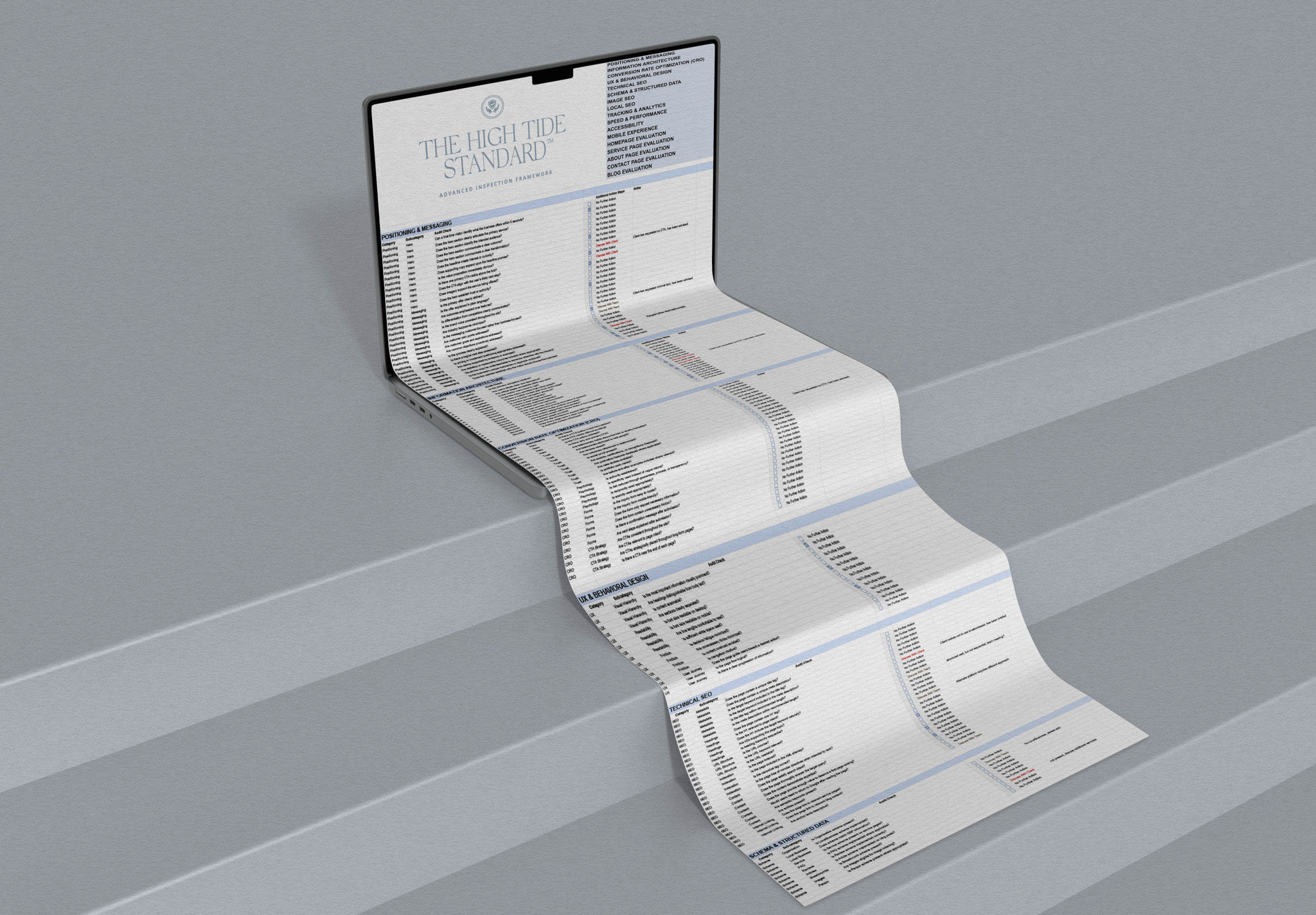
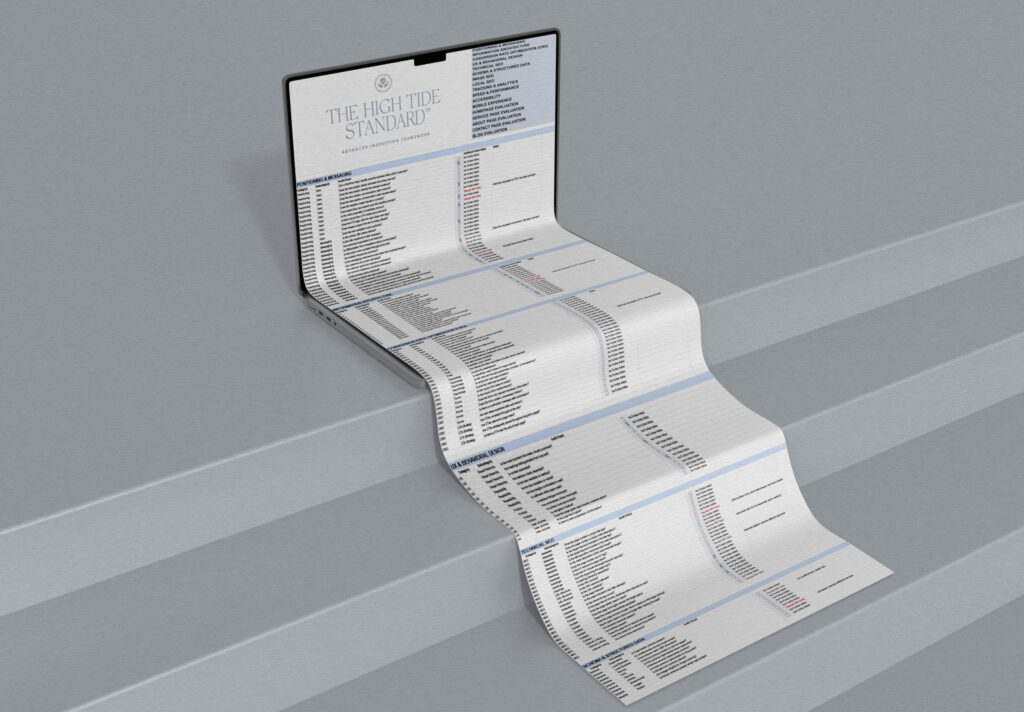
Your designer should be able to explain which technical checks they’ll be benchmarking at the beginning, as well as after launch, and what happens if something is wrong.
This matters because a beautiful site can still create problems if search platforms cannot crawl, index, or understand the content properly.
I would want to know what systems are in place to check redirects, broken links, metadata, mobile performance, page speed, indexing settings, sitemap issues, and anything else that could affect visibility.
At High Tide Strategy, we treat this as a pre-launch quality check, not a last-minute task. We review the technical pieces that support both search performance and the visitor experience before the site goes live.
This is where technical SEO before a website launch becomes part of protecting the redesign, not something you troubleshoot after traffic drops.
Your designer should be able to explain how your tracking and search data will carry through the redesign.
This matters because you need continuity. If analytics tracking breaks or Search Console errors are ignored, it becomes much harder to understand your post-launch performance.
I would want to know who is responsible for checking GA4, Search Console, sitemap submission, and whether important events or conversions are still being tracked correctly.
At High Tide Strategy, we make sure the measurement side of the site is accounted for before launch. Our tracking codes are implemented on your behalf with clear This gives us a clean baseline and helps us catch changes in traffic, visibility, and conversions quickly.
This is also where tracking SEO performance after a website redesign becomes much easier when the right systems are already in place.
Your designer should be able to explain what they are watching after launch, not just hand over the site and disappear.
This matters because some SEO issues do not show up immediately. Rankings can shift, redirects can fail, pages can drop out of the index, and traffic patterns can change.
I would want to know who is monitoring rankings, organic traffic, Search Console data, 404s, indexation, and the pages that mattered most before the redesign.
At High Tide Strategy, we compare your initial post-launch performance against the benchmarks we captured before the build. Our site builds come with 7 days of post-project support to walk you through any errors or concerns we may encounter once the launch is live. This helps us spot meaningful changes quickly, get a firm understanding of our initial progress, and separate normal fluctuation from something that actually needs attention.
In my opinion, knowing what to monitor after launching a redesigned website and sticking around long enough to track it should be a required part of the designer’s job.
This is arguably one of the most important questions you should ask before hiring a Showit Website designer. Do not hire a Showit website designer without a clear expectations on site performance and navigating your traffic changes post-launch.
Some dips in traffic after launch can be normal (and even expected). A meaningful drop in rankings or traffic is different, and someone needs to know how to diagnose the initial performance reporting to forecast where to put energy moving forward.
I would want to know who is responsible for reviewing what changed, checking redirects, comparing pre-launch benchmarks, looking at Search Console, and identifying where visibility was lost.
At High Tide Strategy, we do not treat your Showit Website launch as the finish line. We compare post-launch performance against the benchmarks we captured before the redesign and investigate anything that looks off. (and we’ll give you a custom 20-30 minute tutorial so you can understand the “why” behind what we did and walk away with confidence.
In my opinion, if someone is responsible for rebuilding your site, they should also be prepared to help explain what happened if performance changes afterward.
This is where accountability matters just as much as implementation.
Hiring the wrong Showit website designer or SEO expert can create problems that go far beyond a site you simply do not love.
You can lose rankings, traffic, backlinks, conversion paths, and years of search history in the process. Even worse, you may not realize what disappeared until inquiries slow down or Google stops sending the visitors you once relied on.
This is why I would be cautious about choosing an SEO add-on simply because it makes the website package more affordable.
Saving money upfront can feel like the smarter decision. If the SEO work only covers the basics, however, you may spend far more later rebuilding rankings, repairing technical issues, and figuring out what went wrong.
At High Tide Strategy, we built our website process around the opposite approach. SEO, conversion strategy, copywriting, site architecture, and design all inform each other from the beginning. We are not trying to bolt SEO onto a finished website after the important decisions have already been made.
If you already have organic visibility, this matters even more. You need someone who knows how to protect it while creating something better.
A redesign should move your business forward without forcing you to rebuild the search reputation you already earned.
If you are comparing designers right now, use these 15 questions as an interview template for your Website Designer BEFORE you hire them. Listen closely to the answers. The right partner should be able to explain not only what they will do, but why they are doing it and what they are protecting along the way.
If you are looking for a Showit website designer who can blend sophisticated design with SEO, conversion strategy, and marketing expertise, this is exactly where High Tide Strategy fits.
We do not approach your website as a collection of pretty pages. We build websites with strategy we can defend with data. (Like…. so much data).
We look at how the site needs to perform, what your current SEO is already doing, where visitors are entering, what needs to be protected, and how the new design can support stronger visibility and better inquiries.
Our work is especially well suited for photographers, wedding professionals, and creative brands who want a site that feels elevated without sacrificing performance.
This is where fine art design and strategy need to work together. Each project brings together a collaborative team of Strategists, Designers, Copywriters, and your own Personal Project manager, it’s all hands on deck to bring you an optimized, high converting website tailored to your vision in just 7 days. Learn more about our Showit Website In A Week Process.
Your website should reflect the caliber of client you want to attract. It should also make it easy for search platforms to understand what you do, help visitors move toward inquiry, and protect the authority your business has already built.
Mandy Ford and the High Tide Strategy team bring SEO research, keyword mapping, conversion copywriting, site architecture, technical SEO, and refined Showit design into the same process.
You are not hiring one person for design and hoping someone else can make the strategy fit afterward.
You are getting a website built with the full picture in mind from the beginning.
If you are planning a Showit redesign and want someone who understands both the creative and technical sides of the project, schedule your Showit Website Design consultation with Mandy.
We will look at where your site is now, what needs to change, what should stay protected, and what the next version of your website needs to do for your business.

Mandy Ford is the founder and lead strategist behind High Tide Strategy, a full-service marketing studio specializing in SEO for photographers, Showit website design, and digital marketing for creative businesses. She helps photographers, wedding professionals, and creative brands build stronger visibility across Google, AI search, and social search… then turn that visibility into qualified inquiries. Known for looking beyond surface-level SEO tactics, Mandy’s approach connects search strategy, website design, and aesthetics to build businesses that are easier to find, understand, trust, and hire online. Want to see if we’re a great fit? Reach out to schedule your free consultation.
"They made everything feel very intentional and strategic from the beginning. They took the time to understand not just my business, but the type of clients I want to attract. That gave me a lot of confidence that the investment would actually move the needle, not just improve aesthetics...."
- Catherine Cortes, RI Wedding Photographer
"I felt comfortable investing in a website design with High Tide Strategy because there is a team of people working on my website who knows their stuff when it comes to SEO, while also making my website aesthetic, and on top of that they get your website back to you within a week which is super nice!"
- Emma Rose Photography
"Mandy and her team stay on top of the latest marketing strategies and genuinely care about helping business owners succeed. I am so grateful I chose to work with them."
- Erica Ewing, Photographer & Business Coach
A full-service digital marketing agency specializing in Showit website design, Shopify website design, SEO for creatives, and paid ad strategy across Pinterest, Meta, and Google. We help photographers, small business owners, and creative entrepreneurs build intentional brands that align with their vision and drive measurable results. Our signature services include social media marketing, Pinterest management, and 7-Day SEO and Ad Strategy Surges — all designed to increase visibility, improve conversions, and simplify growth. At High Tide Strategy, we combine data-driven strategy with refined design to create marketing systems that are both beautiful and built to perform.

